
The International English Language Testing System (IELTS) is a test that helps universities to assess the English skills of applicants wishing to study or train in the English language. It is used as a general test of English for immigration and employment in many countries. There is no pass or fail marks in the IELTS test. The applicants are assessed on a band scale of 1 to 9 in each module of the test. Band 9 being for the expert user. Depending upon various English language requirements, colleges and countries decide which IELTS band score is suitable for their applicants.
Applicants must choose to sit either the ACADEMIC or the GENERAL training IELTS test. The Academic IELTS test is for those who plan to study English in university and is designed to test the understanding and use of complex academic language. While the General Training IELTS test is for the ones requiring a more general level of English proficiency for college, high school, employment or immigration purposes.
IELTS Test Format
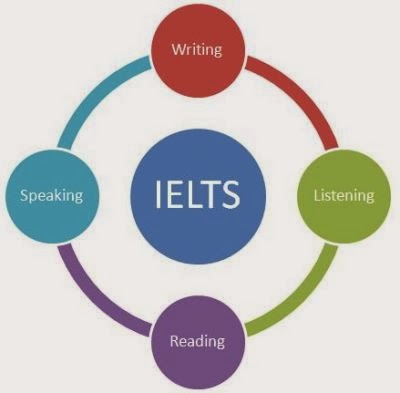
It consists of four modules, namely LISTENING, READING, WRITING and SPEAKING.1. IELTS Listening test
It consists around 40 questions. The time duration for the listening test is approximately 30 minutes. The audio is played once and the applicants are given 10 minutes at the end to transfer their answers to the listening answer sheet. The structure of the test is given below:| SECTIONS | TASK DESRIPTION |
|---|---|
| Section 1 | A dialogue between two people talking about everyday situations |
| Section 2 | A monologue, a talk given by one person about a general topic. E.g. A trip |
| Section 3 | A discussion between two or four people about an education-related topic |
| Section 4 | A monologue in the form of a lecture on an academic topic |
2. IELTS Reading test
Just like the listening test, reading test also has 40 questions to be answered. The time duration for the reading test is around 60 minutes including the time required to transfer the answers to the reading answer sheets. It consists of three or sometimes four reading passages of increasing difficulty with each section. The structure of the test is given below:| SECTIONS | TASK DESRIPTION |
|---|---|
| Section 1 | Text relating to everyday situations. E.g. advertisements |
| Section 2 | Text focusing on work-related situations. E.g job descriptions |
| Section 3 | 1 longer text on a general topic from newspapers, journals etc. |
3. IELTS Writing test
The writing test is for around 60 minutes and the candidate needs to complete two writing tasks. Task 2 carries more weight than task 1. The structure of the test is given below:| TASKS | TASK DESRIPTION |
|---|---|
| Task 1 | Writing a formal/informal letter in response to a problem or issue stated or writing a summary in response to a graph, table, chart etc. in 150 words. |
| Task 2 | Writing an essay in response to an issue or an argument in 250 words |
4. IELTS speaking test
The speaking test is the first/final part of the exam. It need not be taken on the same day as the other tests. It takes the form of a three-part oral interview, which takes between 10-15 minutes.| TASK | TIME | TASK DESRIPTION |
|---|---|---|
Part
1
Introduction &
Interview |
4-5 mins | Give your name and talk about things which are personal to you e.g your family, hobbies, your country etc. |
Part
2
Individual
long turn |
3-4 mins | A topic is given to you about a person, place, event etc. and you have 1 minute to prepare and speak on it for 1-2 minutes |
Part
3
Two way
Discussion |
4-5 mins | Examiner generates a discussion relating to the topic introduced in Part 2. The discussion will be on less personal topics. |

Comments
Post a Comment